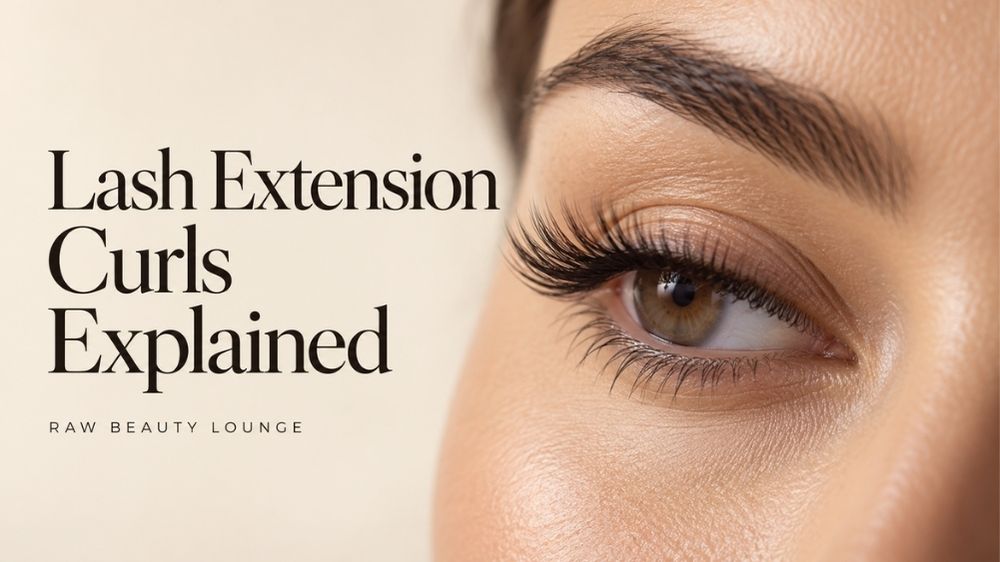
Lash Extension Curls Explained How Artists Choose a Curl
Ever see a lash menu filled with letters and wonder what they mean? C, CC, D, L, and M are not secret salon codes. They describe how an extension bends. That small curve can change how open, soft, or dramatic your eyes appear. At Raw Beauty Lounge, we believe the right curl starts with your natural lashes and your goals, not a trend.
This guide explains each curl, what artists consider during a consultation, and how curl interacts with length, fullness, comfort, and care. You will also learn what questions to ask before booking. You do not need to memorize every letter. You only need enough knowledge to make a choice that feels like you.
What Is a Lash Extension Curl?
A lash extension curl describes the bend built into an individual synthetic extension. Some curves are nearly straight. Others lift sharply upward. Artists select curls to help extensions complement the angle and strength of your own lashes. Curl is one part of a design, alongside length, diameter, placement, and fullness.
Imagine two extensions that measure the same length. One rises gently. The other arches tightly. They can look completely different from the front. The tighter curve might look shorter from some angles. The gentler one might extend farther outward. That is why comparing only millimeters never tells the full story.
Curl labels are useful shorthand, but they are not universal measurements. The shape of a C curl may differ between manufacturers. Your artist should examine the actual product, not rely solely on its letter. A good lash consultation turns those technical choices into a look you can understand.
Quick Lash Curl Comparison: J, B, C, CC, D, L, and M
J Curl: An Almost-Straight Finish
J curl offers a gentle bend close to many naturally straight lashes. It can create a quiet, understated result when the natural lash direction supports it. However, J curl is not a universal choice for downward-growing lashes. A soft curve may follow those lashes downward instead of opening the eye.
Choose J when you want minimal visible curl and your artist confirms a suitable natural lash angle. Think soft definition rather than a pronounced lift. Availability varies by studio, so ask which subtle curls your location actually stocks.
B Curl: Gentle Everyday Lift
B curl adds a little more bend than J. It can blend beautifully with naturally lifted lashes and a barely-there makeup style. Clients seeking a conservative office look often appreciate this visual softness. The result still depends on extension length, lash density, and the shape of the eye.
B curl may suit a first appointment when you want a gradual change. Your artist might use it strategically in corners or blend it with other curls. There is no single best curl for every person, even when two clients ask for the same natural look.
C Curl: A Balanced, Popular Shape
C curl provides an obvious upward sweep without reaching the strongest dramatic bend. Many people recognize it as the classic lash extension look. It can add definition and make the eye appear more open. C curl often works in classic, hybrid, and volume designs.
If you bring a reference picture showing polished but wearable lashes, C curl may be part of the plan. Yet a C curl alone cannot reproduce a photo. Mapping, natural lash count, and overall density change the result. Ask your artist what your particular lashes can support.
CC Curl: More Lift Without Full Drama
CC curl generally sits between C and D in visible curvature. It can create a brighter, more lifted appearance while staying wearable for everyday life. Some artists use CC for clients who find C too subtle and D too bold. It can also be blended across different sections of the lash line.
Do not assume CC works identically on every eye. The angle of natural lashes changes how the same curl appears. A consultation should test the goal against your lash direction and eyelid shape. That matters more than choosing the most popular letter.
D Curl: Bold, Noticeable Curvature
D curl makes a stronger arc and often supports a dramatic, wide-eyed look. It may suit clients who enjoy prominent lashes in photographs or full makeup. But dramatic appearance and suitable attachment are separate questions. A very curved extension may have less convenient contact with certain natural lash directions.
More curl does not automatically mean better lift or longer wear. On some lash lines, a D curl may rotate, look overly curled, or compete with the eyelid. A skilled artist balances impact against safe length, weight, and contact. Your natural lashes make the final call.
L and L+ Curls: A Straighter Base With an Upward Turn
L-style curls begin with a flatter base and then rise into a visible bend. That shape can make sense when standard rounded curls disappear beneath certain lids or do not align well with straight lashes. L+ variations differ by supplier and can create a striking lifted silhouette.
An L curl is not a guaranteed fix for hooded eyes. Placement and eyelid movement still matter. If the base does not suit the natural lash, an unusual silhouette will not solve the attachment problem. Your artist should assess the eye open and closed.
M Curl: Lift With a Distinct Profile
M curls are designed with a different rise than a traditional C or D curve. They can create a strong visible lift while maintaining a distinct profile at the base. Some artists favor them for straight or downward-angled natural lashes, depending on the product and individual lash line.
M curl can produce a modern, defined look. It can also seem too sharp when paired with excessive length or dense volume. Ask to see examples on an eye shape similar to yours. Availability and exact construction vary between brands.
C vs CC vs D: Which Curl Should You Choose?
Start with your desired finish. C tends to read balanced. CC increases visible lift. D feels more dramatic. Those descriptions help narrow the conversation, but they cannot replace a lash assessment. Two people wearing the same curl can have very different results.
A useful decision is not, ‘Which letter is best?’ It is, ‘How do I want my eyes to look during a normal day?’ Someone who wears little makeup might love C. Someone who wants extra definition for events might prefer CC. Someone with compatible lashes and a bolder style might choose D.
Your artist might combine two curls instead of committing to one. A softer curl near the inner corner can transition into a more lifted center. A different outer-corner shape may prevent a drooping appearance. Mixing requires deliberate mapping, not random switching.
How Lash Artists Actually Choose a Curl
Step 1: Listen to Your Goal
A thorough consultation begins with what you want. Bring one or two clear photos. Say whether you favor natural, lifted, wispy, or bold results. Also explain what you dislike. ‘I do not want lashes touching my glasses’ is more useful than naming a curl you saw online.
A stylist should ask about your schedule and upkeep expectations. Brides may need a reliable plan before wedding week. Busy professionals may value easy maintenance. First-timers may prefer a modest starting design. Your real life is part of your lash map.
Step 2: Check Natural Lash Direction
Natural lashes may point upward, forward, or downward. They can also change direction across one eye. A curl that looks lifted on upward lashes might look less visible on downward lashes. Artists inspect the base, growth angle, and available bonding surface before selecting a shape.
This step helps avoid a common misunderstanding. A curl letter does not mechanically lift the natural lash like a lash lift treatment. An extension is attached to that lash. Its visible angle depends on both the extension and the hair carrying it.
Step 3: Assess Strength, Length, and Density
The artist then checks whether your lashes can carry the proposed extensions. Fine or sparse lashes may need a lighter design. Healthy-looking lashes do not justify unlimited weight. Diameter, length, and fan construction all affect how much material each natural lash supports.
The safest beautiful set is a sustainable set. Choosing the boldest extension available may bring short-term impact but poor long-term comfort. You should never feel pressured to select more length, more density, or a curl that your artist considers unsuitable.
Step 4: Review Eye Shape and Lid Space
Eye shape offers clues, not rigid rules. Hooded, round, almond, downturned, deep-set, and monolid eyes can each support many designs. The distance between lash line and lid crease, brow position, and natural lash angle all influence what appears flattering.
Artists should look at you with eyes open and closed. A style that looks lovely on a closed eye may hide behind a lid when open. A dramatic outer corner can lengthen one eye visually yet pull another downward. Observing movement matters.
Step 5: Build a Lash Map
A lash map is the placement plan for curl, length, and density across the lash line. It guides the artist from inner to outer corner. A map may emphasize the center for an open-eye effect or shift length outward for a softer cat-eye impression.
The map should reflect your natural lash growth. An artist may shorten fragile corners, change curls across zones, or reduce density where coverage is lighter. Good mapping respects unevenness rather than hiding every difference beneath heavy extensions.
Step 6: Confirm Comfort and Aftercare
Before application, discuss sensitivities, previous reactions, and practical aftercare. Lash extensions are applied near the eyes using adhesives. Burning, significant pain, or persistent irritation should not be treated as a normal beauty tradeoff. If you have an active eye problem, delay service and seek appropriate medical advice.
Ask how to cleanse the set and when to return for a fill. A responsible artist should explain what normal shedding looks like and what merits contacting the studio. Feeling informed is part of receiving good service.
Which Curl Flatters Different Eye Shapes?
Almond Eyes
Almond eyes often suit several curl families. A C or CC curl can preserve their natural balance. If you want more lift, your artist may adjust the center or outer third. There is no need to chase maximum curl just because a photo shows it.
Round Eyes
Round eyes may benefit from strategic placement that balances openness and length. A stronger center lift can emphasize roundness. A carefully shaped outer third can create a more elongated impression. Your preferred result determines which direction makes sense.
Hooded or Deep-Set Eyes
For some hooded eyes, the lid can hide rounded curl shapes. Certain L-style or M-style designs may remain more visible. However, stronger curvature can also approach the lid or feel visually crowded. The artist should test practical lid clearance and appearance.
Downturned Eyes
An elongated cat-eye map can sometimes make downturned corners look lower. A shorter outer corner and strategically placed lift may suit better. Curl choice alone does not determine this effect. Mapping and where the longest lashes sit matter just as much.
Monolid or Straight-Lash Eyes
A flat or forward-facing natural lash line needs individualized planning. A curl that arches visibly from the front may still attach poorly if its base is mismatched. Some clients may prefer L or M shapes, while others do well with C variations. Your artist should assess the actual hairs.
Mature Eyes and Changing Lash Density
Natural lash density and strength can change over time. A lighter, shorter set with well-placed lift may feel more comfortable than a heavy dramatic set. Some people prefer subtle C designs. Others choose selective specialty curls. Age alone does not dictate your curl.
Curl vs Length vs Thickness: Three Different Decisions
Curl is how the extension bends. Length is how far its fiber measures from base to tip. Thickness refers to its diameter. These choices interact, but one cannot substitute for another. More length will not necessarily create lift. More curl will not necessarily create fullness.
Suppose you like a light, lifted style. A moderate curl with shorter fibers may create it. A longer extension in the same curl could look heavier or more dramatic. A denser volume technique could change the appearance again. These are separate design levers.
When reviewing a reference image, ask which part you like. Is it the upward curve, dark lash line, airy texture, or outer-corner shape? That question can prevent an artist from increasing length when the real request is better lift.
Classic, Hybrid, and Volume Lashes Can Use Different Curls
Classic Lash Extensions
Classic sets typically attach one extension to one suitable natural lash. They often create neat definition. The curl determines how lifted that line appears, but it does not create extra natural lash hairs. If your lash line is sparse, classic may remain delicate even with a bold curl.
Hybrid Lash Extensions
Hybrid sets combine classic styling with volume techniques. They can offer mixed texture and moderate fullness. C or CC curls may work well, but the available curl range depends on the artist and products. A hybrid label does not promise a particular curl.
Volume Lash Extensions
Volume styling uses lightweight fans of multiple fine extensions on suitable natural lashes. The number, weight, and placement require careful assessment. A D curl volume set can look very different from a C curl volume set. Neither label tells you whether the final weight is appropriate.
See our lash services for current treatment options and discuss the result you want before selecting a set. You can also browse our before-and-after gallery to identify whether you love natural definition, lifted glamour, or fuller texture.
Can the Wrong Curl Damage Natural Lashes?
A curl letter by itself does not prove damage. Problems arise when the overall application is unsuitable. Heavy or excessively long extensions, poor isolation, poor placement, and inappropriate bonding can contribute to discomfort or lash stress. Repeated pulling or picking can also harm natural lashes.
A dramatic curl may be challenging on a certain lash direction, but that does not mean D curls always damage lashes. Likewise, a gentle curl does not guarantee safety. The full design, application technique, adhesive handling, and hygiene matter.
Look for lashes that feel comfortable and move separately. Extensions should not pull several natural lashes together. Persistent pain, swelling, redness, or discharge deserves prompt professional attention. Do not try to solve a painful set by pulling the extensions off yourself.
Do Stronger Curls Fall Out Faster?
Not necessarily. Lash retention depends on several factors, including natural lash shedding, adhesive technique, attachment contact, oil and product exposure, rubbing, cleansing, and aftercare. Curl can influence attachment geometry, but a tight curl does not come with a universal expiration date.
If extensions shed rapidly, notice what falls. An extension attached to a naturally shed lash can be normal. Several bare extensions falling soon after application may deserve a studio review. A patchy result can also reflect uneven natural growth cycles, not one single mistake.
A useful habit is to photograph the set on day one and again during the following week. Keep notes about unusual shedding or discomfort. This gives your lash artist concrete evidence and avoids guessing whether the problem was the curl, your routine, or the application.
What Makes Lash Extensions Fall Out Quickly?
Natural Lash Growth
Your own lashes shed as part of their growth cycle. An extension attached to a shed lash leaves with it. This is expected and cannot be stopped with a different curl. Fullness changes gradually as individual natural lashes complete their cycles.
Poor Attachment or Unsuitable Mapping
Adhesive contact and placement affect wear. If the extension does not sit securely on the natural lash, retention may suffer. A shape or length that causes twisting or excess movement can also make the set look uneven. This is why assessment comes before fashion.
Rubbing, Picking, and Cleansing Habits
Rubbing your eyes, pulling at extensions, and sleeping with pressure on the lash line can affect appearance. Use cleaning products and techniques recommended by your lash professional. Gentle cleansing keeps debris from building up around the lash line. Never assume avoiding water entirely is healthy aftercare.
Products and Activities
Some skincare, makeup, and cleansing products may interfere with a particular adhesive system. Sweat, heat, and activity can also change how often you touch your eyes. Follow your artist’s product-specific aftercare. Claims that every oil or every humid day automatically ruins lashes are too simplistic.
How Arizona Heat and Everyday Life Affect Your Choice
Clients in Tempe, Gilbert, Glendale, and Chandler often ask about workouts, desert heat, and busy schedules. These are reasonable questions. A curl should look right during daily life, not just in a studio mirror. Think about sunscreen, glasses, hats, makeup habits, and how often you swim.
Arizona’s dry conditions and seasonal heat do not mean everyone needs D curl. Climate also does not replace proper cleansing or sound application. If you spend long days outdoors, describe your routine honestly. Your artist can suggest manageable length, style, and maintenance.
We serve clients across multiple cities, including Kirkland and Omaha. Different weather patterns can influence routines, but natural lash condition remains central. Local details should guide a practical conversation rather than become a shortcut for choosing a curl.
What About Glasses, Contacts, and Sensitive Eyes?
If you wear glasses, check whether your proposed lash length touches the lenses. Curl and length influence that clearance together. Bring your everyday glasses to the consultation when possible. Contact lens users should ask about the studio’s preparation rules and eye comfort.
Tell your artist about previous reactions to adhesives, tapes, or eye products. A prior allergy deserves careful attention. Patch testing does not guarantee that an allergic reaction will not occur. If you develop swelling, significant irritation, or breathing symptoms, obtain appropriate medical care.
An attractive result should never require enduring pain. If your eyes are red, infected, or recently treated, ask a qualified clinician whether a cosmetic lash service is appropriate. Good studios understand that sometimes the right appointment decision is to postpone.
Can You Mix Lash Extension Curls in One Set?
Yes, trained artists may combine curl types across the lash line. They may use one curl for inner corners and another through the middle. A transition can help balance natural direction changes or create a soft shift from everyday to glam. The purpose should be visible harmony.
Blending curls is not always necessary. Using one curl consistently may deliver the cleanest result for some clients. More complex does not automatically mean more flattering. Ask your artist why a mixed map supports your eye shape instead of choosing complexity for its own sake.
Common Curl Selection Mistakes
Copying a Photo Without Considering Natural Lashes
Reference pictures are great conversation starters, not guarantees. Lighting, makeup, filters, and eye shape can change how a set appears. A responsible stylist explains what can be recreated and what needs adaptation.
Choosing the Tightest Curl for Maximum Lift
More curvature can create stronger visible definition. It can also look overwhelming or sit awkwardly on certain lash lines. Lift is a relationship between the extension shape, attachment, and mapping. The strongest letter is not always the smartest choice.
Ignoring Lash Length and Weight
A comfortable curl can become uncomfortable when paired with unsuitable length or weight. The professional should assess each natural lash. Do not choose a heavy set solely because it appears fuller in a photograph.
Treating One Eye Shape Rule as Universal
Advice such as ‘hooded eyes need L curls’ is a starting idea, not a prescription. Individual lashes point differently. Eyelid geometry changes across faces. Small adjustments can matter more than broad labels.
Not Planning for Fills
A first set is only the beginning. Regular fills help maintain a consistent appearance as natural lashes shed. Ask how often your own set may need attention and what condition must be met for a fill. Learn about lash refills before committing to a maintenance routine.
How to Explain Your Ideal Lash Curl to Your Artist
Start with adjectives instead of technical letters. Say ‘soft,’ ‘lifted,’ ‘defined,’ ‘wispy,’ or ‘bold.’ Then describe where you want the focus. Do you prefer an open center or a slightly elongated outer edge? Mention whether lashes often hide behind your lids.
Bring a clear photo taken in normal lighting. Point out the part you like. Ask your artist to explain the proposed curl, length range, and fullness. Request a realistic preview of how the design will appear on your features.
You can also ask about comfort, cleansing, fill intervals, and removal. These questions signal that you value healthy long-term wear. The goal is not to test your lash artist. It is to build a shared plan before any adhesive touches your lashes.
What Happens at a Raw Beauty Lounge Lash Consultation?
Our goal is to help you choose a lash look that matches your daily style and natural lash needs. Before booking, review the options on our website and note the outcome you want. Tell us about past lash experiences, sensitivities, and your preferred level of drama.
We recommend discussing available curl types with the specific studio. Inventory and services can change by location. Rather than promising every specialty curl, we encourage a realistic conversation about what the artist can safely create.
If you’re comparing styles, review our team and browse our locations to choose the most convenient studio. Our service details can help you prepare a few questions before your visit. The best appointment is one where you feel heard and understand the plan.
Before Your Appointment: A Simple Checklist
Arrive ready to describe your ideal finish. Bring inspiration pictures and tell the artist which details matter. Mention contacts, glasses, allergies, previous lash problems, and current eye symptoms. Ask whether you should arrive without eye makeup or remove contact lenses.
Discuss your budget and ongoing fill commitment. Ask about pricing for a full set versus regular maintenance. If you’re switching from another salon, tell the artist what extensions you currently have. An evaluation can clarify whether a fill or fresh set makes sense.
Avoid dramatic last-minute changes before a major event. If possible, test a new style early enough to learn whether you like its feel and appearance. Your wedding or trip photos should show confidence, not an experiment you regret.
Aftercare: Keep Your Curl Looking Its Best
Clean Gently and Consistently
Follow the cleanser and timing recommendations your lash professional provides. A clean lash line supports comfort and helps you notice changes. Use gentle motions rather than scrubbing or tugging. Let the lashes dry without excessive rubbing.
Avoid Pulling or DIY Removal
Do not pick at individual extensions when you spot gaps. Pulling can remove natural lashes or irritate skin. Professional removal is usually the safer choice when you want a set taken off. Household oils and improvised solvents are not reliable methods near your eyes.
Book Fills Based on Your Set
As the natural lashes shed, gaps develop. Fill schedules vary by growth cycle, styling, and studio policies. Ask your artist when to return and how much retention they require for a fill. Do not assume a fixed schedule works for everyone.
Watch for Symptoms That Need Attention
Normal wear should not feel painful. Contact a qualified clinician for persistent redness, swelling, discharge, or worsening pain. Your artist can answer styling questions but cannot diagnose an eye condition. If symptoms suggest allergy or infection, put health ahead of the cosmetic schedule.
Frequently Asked Questions About Lash Extension Curls
Is C or D curl better for beginners?
Neither is automatically better. C often creates a balanced finish, while D looks more dramatic. Your natural lash direction and desired style matter more than beginner status. Ask your artist for a conservative design that still meets your goal.
What is the difference between C and CC lashes?
CC usually has more visible curvature than C and less than D. The exact difference varies by manufacturer. CC may work when you want a stronger lifted appearance without the fullest dramatic bend.
What curl looks most natural?
J, B, and some C designs can look natural, depending on your existing lashes. Length, thickness, density, and mapping are equally important. A short C set may appear more natural than a very long J set.
Which curl is best for hooded eyes?
There is no universal answer. Some hooded eyes benefit from L, L+, or M shapes. Others do well with C or CC. An in-person assessment of lid space and natural lash direction is essential.
Are D curls too dramatic for daily wear?
Not necessarily. A short, thoughtfully mapped D curl can be wearable on suitable natural lashes. A long, dense D set can look much bolder. Your makeup habits and personal style help decide.
Can I ask for two curls in one set?
Yes, if the artist stocks both and believes the combination suits your lashes. Mixed mapping can smooth transitions or emphasize selected zones. You do not need multiple curls for a beautiful result.
Does a tighter curl make extensions last longer?
No curl letter guarantees better retention. Adhesive contact, isolation, weight, natural shedding, and aftercare all affect wear. A curl should be selected for both the desired appearance and a suitable attachment.
Are L curls the same as a lash lift?
No. An L curl is a pre-shaped extension fiber. A lash lift is a separate treatment that changes the shape of natural lashes through a chemical process. Discuss which service matches your goals and lash health.
Can I change curls at my next fill?
Sometimes. Your artist may be able to transition the look, depending on the existing extensions and their remaining condition. A dramatic change could require removal and a new full set. Ask before your appointment.
Why do my lashes look different from my inspiration photo?
Your natural lash density, eye shape, viewing angle, and chosen lengths may differ from the model’s. Lighting and retouching also influence photos. Use inspiration as a direction, then let your artist personalize the design.
Do stronger curls feel heavier?
Curl alone does not determine weight. Fiber diameter, length, material, and fan size affect load. The artist should select a safe combination based on your natural lash strength rather than judging by curl label.
Can I wear lash extensions with contact lenses?
Many contact lens wearers choose extensions, but preparation and comfort rules differ. Tell your artist beforehand. Follow their contact lens instructions and seek clinical advice if you have irritation or an eye condition.
What happens if I have an allergic reaction?
Stop using irritating products and seek appropriate medical evaluation. Significant swelling or symptoms involving breathing require urgent care. Do not try to remove extensions using random household products near your eyes.
How can I make my lash extensions last longer?
Follow your artist’s cleansing, handling, and fill instructions. Avoid rubbing or picking. Report unusual early shedding with photos and timing details. Good retention is a combination of sound application and realistic home care.
Should both eyes have exactly the same curl map?
Not always. Many faces have natural asymmetry. A stylist may use subtle adjustments to create a balanced overall appearance. The aim is visual harmony, not necessarily identical measurements on both sides.
The Bottom Line: Choose the Curl That Suits Your Eyes
The right lash extension curl is the one that works with your natural lashes and fits your style. J and B offer subtle definition. C balances softness and lift. CC adds emphasis. D offers bold curvature. L and M shapes provide different profiles for individualized mapping.
The letters are useful, but the consultation matters more. Choose an artist who checks your lashes, explains the tradeoffs, and keeps comfort central. That careful planning helps a finished set look intentional from every angle.
Ready to explore your options? Book an appointment with Raw Beauty Lounge and talk through the look you want. We can help you prepare for a lash service that feels confident, personal, and practical.